




 Whitman Expo
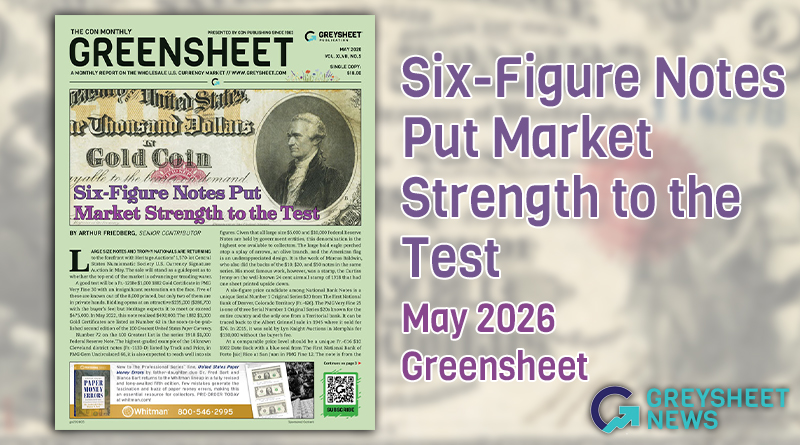
May 2026 Greensheet Market Analysis: Six-Figure Notes Put Market Strength to the Test
Large size notes and trophy nationals are returning to the forefront with Heritage Auctions’ 1,570-lot Central States Numismatic Society U.S. Currency Signature Auction in May.
by Arthur Friedberg |
Published on May 4, 2026

Download the Greysheet app for access to pricing, news, events and your subscriptions.
Subscribe to Greensheet for the industry's most respected pricing and to read more articles just like this.
Advertisement
The sale will stand as a guidepost as to whether the top end of the market is advancing or treading water.
A good test will be a Fr.-1218e $1,000 1882 Gold Certificate in PMG Very Fine 30 with an insignificant restoration on the face. Five of these are known out of the 8,000 printed, but only two of them are in private hands. Bidding opens at an attractive $235,000 ($286,700 with the buyer’s fee) but Heritage expects it to meet or exceed $475,000. In May 2022, this note realized $492,000. The 1882 $1,000 Gold Certificates are listed as Number 62 in the soon-to-be-published second edition of the 100 Greatest United States Paper Currency.
Number 72 on the 100 Greatest list is the series 1918 $1,000 Federal Reserve Note. The highest-graded example of the 14 known Cleveland district notes (Fr.-1133-D) listed by Track and Price, in PMG Gem Uncirculated 66, it is also expected to reach well into six figures. Given that all large size $5,000 and $10,000 Federal Reserve Notes are held by government entities, this denomination is the highest one available to collectors. The large bald eagle perched atop a splay of arrows, an olive branch, and the American flag is an underappreciated design. It is the work of Marcus Baldwin, who also did the backs of the $10, $20, and $50 notes in the same series. His most famous work, however, was a stamp, the Curtiss Jenny on the well-known 24 cent airmail stamp of 1918 that had one sheet printed upside down.
A six-figure price candidate among National Bank Notes is a unique Serial Number 1 Original Series $20 from The First National Bank of Denver, Colorado Territory (Fr.-426). The PMG Very Fine 25 is one of three Serial Number 1 Original Series $20s known for the entire country and the only one from a Territorial bank. It can be traced back to the Albert Grinnell sale in 1945 where it sold for $76. In 2015, it was sold by Lyn Knight Auctions in Memphis for $130,000 without the buyer’s fee.
At a comparable price level should be a unique Fr.-616 $10 1902 Date Back with a blue seal from The First National Bank of Porto [sic] Rico at San Juan in PMG Fine 12. The note is from the only national bank in Puerto Rico and is the only 1902 Blue Seal known from charter number 6484. The last time it sold was in 2023 when it went for $144,000.
Whenever one of the fewer than 150 known Confederate $1,000 Montgomery notes appears in a sale, it becomes the subject of fevered bidding. When it is called Choice About Uncirculated 58 EPQ by PMG, no one knows what to expect, except that it would likely also be over $100,000. PMG says the note being offered is the finest that the service has ever graded. The Montgomery issues were printed in New York by the National Bank Note Company under a subcontract from the American Bank Note Company. The $1,000 is one of the keys to the Confederate series. Haste necessitated the use of already existing design elements, such as the portraits of Andrew Jackson and John C. Calhoun. 607 of these were printed on four subject sheets with a $50, $100, and $500. On April 25, 1861, U.S. government agents raided the American and National Bank Note Company facilities, resulting in the surrender of all printing plates. The $1,000 never really circulated but was considered a bearer instrument that paid 3.65% interest. It is number 20 in the new 100 Greatest.
Other sale highlights include a Fr.-27 $20 1869 Rainbow Note in Gem Uncirculated 67, a Gem Uncirculated 65 $20 1905 Technicolor Gold Certificate (Fr.-1180), and a Fr.-389 Utah Territory Lazy Deuce National.
The paper money world lost two notables in the last two months. Dean Oakes passed away at the age of 89 on March 21. There were not many pieces of United States currency that at one time or another, did not pass through his hands. With John Schwartz, he was the author of several editions of the Standard Guide to Small-Size U.S. Paper Money, 1928 to Date, as well as the Standard Catalog of National Bank Notes with John Hickman. He also authored Iowa Obsolete Notes and Scrip. He was president of the Society of Paper Money Collectors from 1995 to 1997.
William M. (Bill) Rosenblum died on March 10 at 80. He was one of the world’s leading experts on the coins and paper money of Israel, from the days of ancient Judea to the Palestinian Mandate and on through the modern issues of the state of Israel. He issued more than 250 auction catalogs and price lists and was a contributor to Whitman’s Modern World Coins and Gold Coins of the World. He was also a lifelong devotee of the New York Yankees, with whom, during the season, I would commiserate on an almost daily basis. In our last conversation, not long before he passed, he could not understand why Aaron Boone was still their manager given that he did not know how to run a bullpen.

Related Stories (powered by Greysheet News)
View all news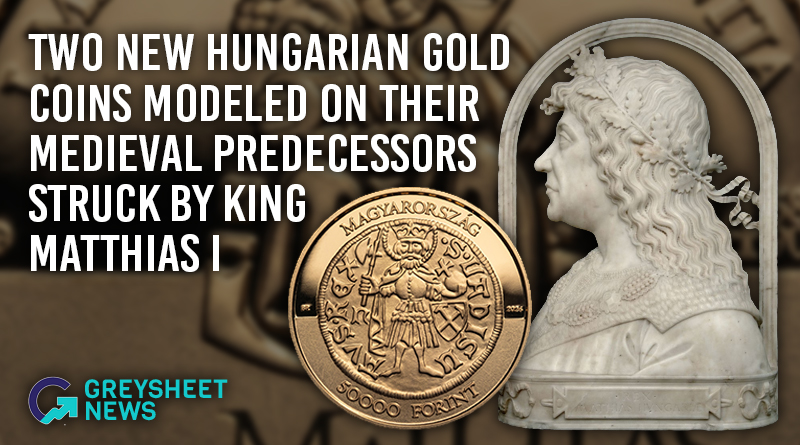
In 2026, The Hungarian Mint is issuing a gold collector coin called “The Gold Florin of Matthias I”, in single-ducat weight and quadruple-ducat weight (piedfort) versions, as well as a base metal version in a copper-nickel-zinc alloy.

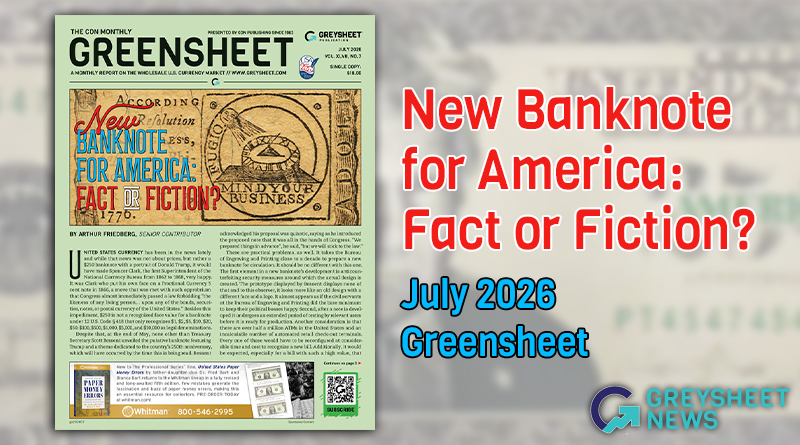
At the end of May, Treasury Secretary Scott Bessent unveiled a $250 banknote featuring Trump and a theme dedicated to the country's 250th anniversary.

Two Month Ordering Window Open Until June 30. After That Date, Mintage Will Be Set. Reservations Can No Longer Be Guaranteed.
Please sign in or register to leave a comment.
Your identity will be restricted to first name/last initial, or a user ID you create.
Comment
Comments