




 Whitman Expo
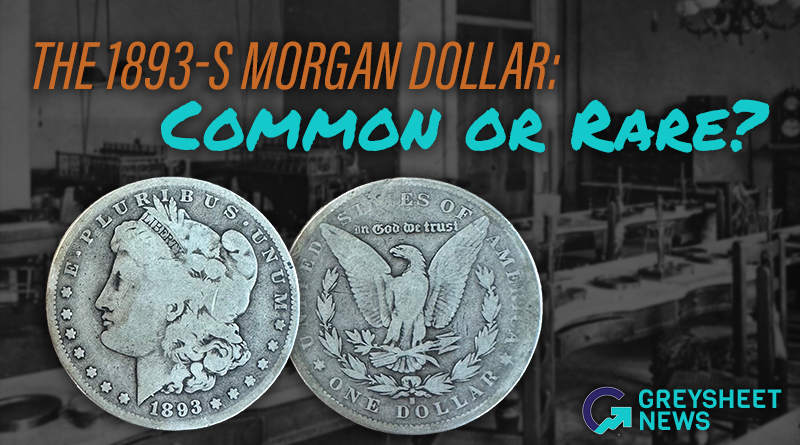
The 1893-S Morgan Dollar: Common or Rare?
Numismatic publicist Donn Pearlman, writing in The Numismatist in 1986, said, "[T]here are so many examples of misleading statements, misinterpretations and misguided advice that some numismatic literature could compete for the Clifford Irving Award for Contemporary Fiction."
by CDN Publishing |
Published on May 13, 2026

Download the Greysheet app for access to pricing, news, events and your subscriptions.
Subscribe to The Greysheet for the industry's most respected pricing and to read more articles just like this.
Advertisement
By Eric Brothers, Contributor
Much of the "fiction" Pearlman referenced is about "rare" coins and what makes them "rare." In essence, very few coins are actually rare, but some numismatic authors simply repeat what they have read elsewhere without doing much, if any, new research about a coin's "rarity."
Confusion About Rarity vs. Price
Our case in point: "How rare is the 1893-S Morgan dollar?" More importantly, what determines if a coin is indeed rare or not? There has always been confusion between rarity and price. Writes H.D. Gibbs in The Numismatist (1934), "One of the commonest questions asked by numismatists is: 'What makes a coin rare?' What most people mean by this question is: 'What makes a coin sell for a high price?', and there is no relation between the two."
The confusion between rarity and price is not helped by what experts write on the subject. For example, Q. David Bowers wrote in 1994, "Rarity can take many forms. In the most classical sense, a rare coin is one of which only a few exist, or, as strange as it may seem, one of which quite a few exist, but nevertheless are highly priced." Huh? How is the second example ever a case of "rarity"?
Continues Gibbs, "Many American catalogues fairly bristle with the descriptions 'Rare', 'Very Rare', or 'Extremely Rare', and I sometimes wonder if we Americans know what those terms mean."
1893-S Rare in "Higher Grades"
Bowers writes, "The 1893-S is the rarest of all Morgan dollars in higher grades." He tells us that it is not an "impossible" rarity due to the existence of thousands of worn pieces of the 1893-S. Bowers reports that he was offered "250 circulated [raw] pieces in 1987."
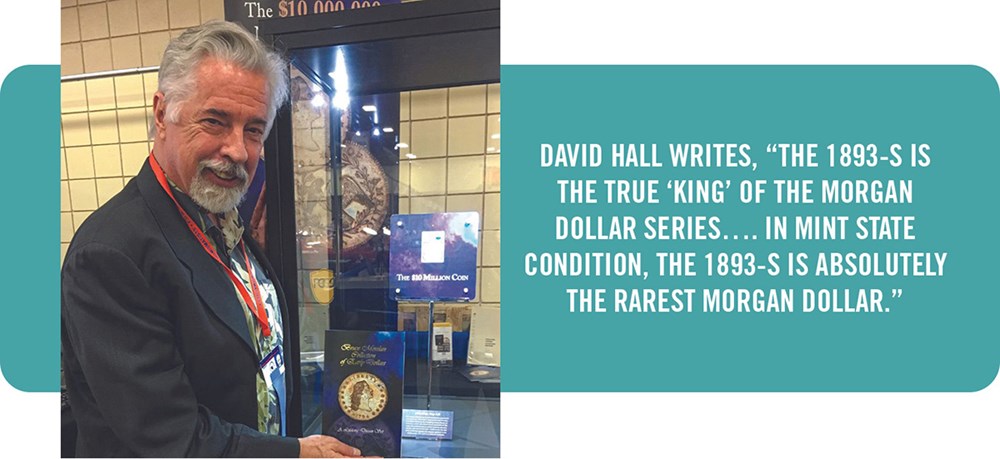
David Hall writes, "The 1893-S is the true 'King' of the Morgan dollar series…. In Mint State condition, the 1893-S is absolutely the rarest Morgan dollar." Hall reports that the PCGS Coinfacts estimated the survival for all grades is 9,948. However, since PCGS Coinfacts does not date its entries, we don't know the year of that estimate. Bowers has estimated that there are between 6,000 and 12,000 surviving pieces of the 1893-S. Nonetheless, research suggests there are many more survivors, perhaps about 25,000—which would dispel the notion that the 1893-S is a great rarity. Before examining the evidence, we shall discuss the mintage and distribution of this famous coin.
Why a Mintage of Only 100,000?
It was the Sherman Silver Purchase Act of 1890 that forced the Treasury to purchase 4.5 million ounces of silver bullion each and every month, and turn a significant amount of it into silver dollars. That was in addition to the Bland-Allison Act of 1878 that compelled the Treasury to buy at least $2 million worth of silver bullion each month and produce silver dollars with all of it. Thus, the literal non-stop production of silver dollars from 1878 to 1892 resulted in the vaults of the U.S. Mints being packed to the rafters. Relatively few Morgan dollars circulated. They simply were not needed in the economy.
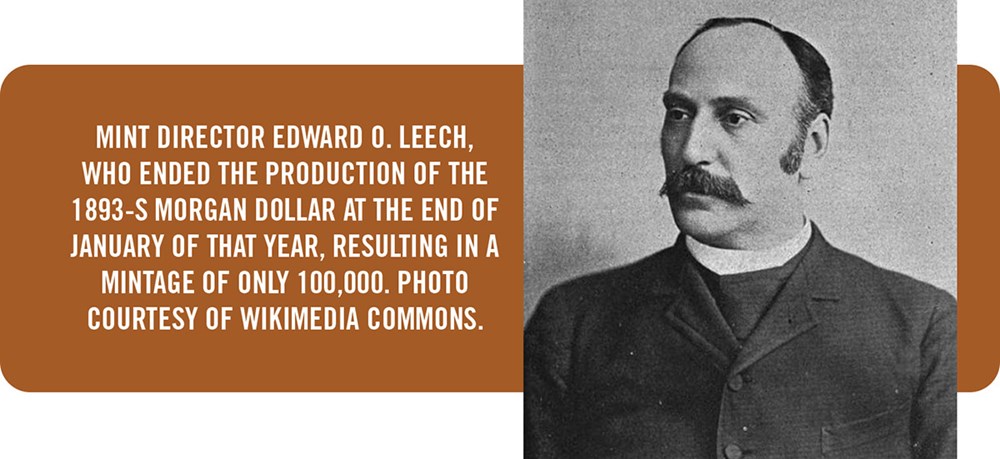
January 12, 1893, saw Mint Director Edward O. Leech send a telegram to the superintendent of the San Francisco Mint: "As the needs of the Treasury do not require the further coinage of silver dollars at your mint, the same will be suspended for the present, after the close of this month." It is important to note that this was before the Panic of 1893 that began in May and the later repeal in October of the Sherman Silver Purchase Act.
Where Did the 1893-S Dollars Go?
Was this issue melted under the terms of the Pittman Act? No. The evidence: In response to a query to purchase 1893-S dollars dated June 1894, chief clerk of the San Francisco Mint Robert Burnett wrote, "All 1893-S dollars have been distributed." But where did they go?
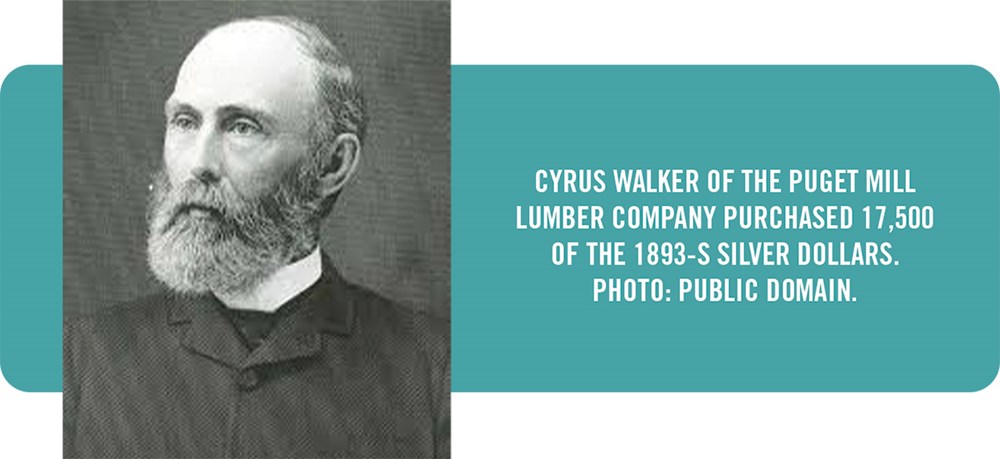
Richard Kelly and Nancy Oliver did extensive research on the distribution of the 1893-S. They cite Cyrus Walker of Port Gamble, Washington. In his role as part owner of the Puget Mill Lumber Company, between July and October 1893, Walker acquired 17,500 silver dollars. It is possible that the coins were earmarked for the mill's payroll.
A report in the August 30, 1893, edition of the San Francisco Chronicle provides more evidence of distribution of 1893-S dollars: "Lately there has been considerable demand at the Mint for silver dollars, the parties desiring them exchanging gold for the silver. On Monday [August 26], $16,000 in silver dollars was exchanged for gold at the Mint." Those two separate purchases equal 33,500 pieces leaving the Mint.
A third large purchase from the Mint has been documented. The coins were purchased by Robert Richard Bulmore, who served as general agent of the Almaden Quicksilver Mine in Santa Clara County, California. There were six acquisitions by Bulmore from July to October 1893, totaling 21,700 examples of the 1893-S dollar.
Those three purchases total 55,200 pieces—over half the total mintage of 100,000. During 1893, banks and other businesses purchased the remaining coins.
However, some of the coins were purchased by collectors. Kelly and Oliver documented three numismatists receiving uncirculated specimens. The first was Fontaine (no first name was recorded), who received his coin in early July of 1893. That was followed by George W. Rice, who received two pieces: one on July 27 and the other on August 10. Peter Mongey also acquired two 1893-S dollars; they were sent to him on October 27. But how many 1893-S dollars survive today in the 21st century?
Certified 1893-S Dollars
Let's examine data from the grading services to learn how many are in holders (as of March 13, 2026):
- PCGS (Professional Coin Grading Service)
- Total Graded: 8,007
- Mint State (MS60 or finer): 38 (Included in above figure)
- Details Grade: Unknown. PCGS does not publish their Details Grade census.
- NGC (Numismatic Guaranty Company)
- Total Graded: 6,349
- Mint State (MS60 or finer): 29 (Included in above figure)
- Details Grade: 2,365
- ICG (Independent Coin Grading)
- Total Graded: 815
- Mint State (MS60 or finer): 3 (Included in above figure)
- Details Grade: Unknown. ICG does not publish their Details Grade census.
- ANACS
- Total Graded: 2,566
- Mint State (MS60 or finer): 2 (Included in above figure)
- Details Grade: 2,442
- CAC (Certified Acceptance Corporation) Grading
- Total Graded: 83
- Mint State (MS60 or finer): 0
- Details Grade: 37
Grand Total Graded: 22,664
Grand Total Mint State: 72 (Included in above figure)
Around 25,000 Pieces Exist of the 1893-S
However, it appears that there are even more. Bowers wrote in 1993, "I believe that about 4,000 to 8,000 circulated 1893-S dollars exist, but this estimate may be on the low side." Also, the fact that not one 1893-S dollar was melted for the Pittman Act suggests a decent number of survivors. For example, PCGS and ICG do not publish their Details Grade population. We can approximate that there are around 2,500 PCGS Details Grade 1893-S dollars, similar to both ANACS and NGC individually. Therefore, a conservative estimate of survivors would be about 25,000 pieces. The market perception of the 1893-S being rare does not align with the reality of its surviving population. (Unknown population factors such as crossover grading and re-holdering will affect population numbers).
It was in 2004 that award-winning numismatist William H. Cowburn, Jr., wrote in The Numismatist, "If 'rare' is applied when tens of thousands of examples are available to the public, we must be skeptical …" Furthermore, he writes, "If more than 1,000 examples of an item are available, then it generally is not considered rare."
1893-S: Absolute or Condition Rarity?
There are two types of rare coins: condition rarities and absolute rarities. A condition rarity is given its value due to its high level of preservation, while an absolute rarity is based upon the total amount known to exist. A condition rarity is common in lower grades. I argue that the 1893-S dollar is a condition rarity.
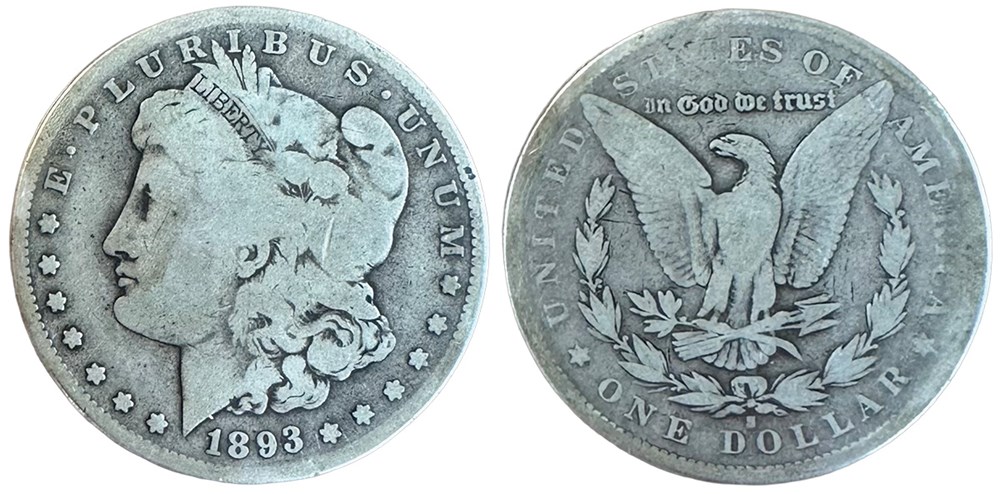
As discussed, the 1893-S is a great rarity in mint state grades, with a total of only 72 pieces graded MS60 to MS67 by the grading services. In the AU grades, this issue moves into the scarce category. The below chart presents total AU grades combined from PCGS, NGC, ICG, and ANACS. CACG has not graded any as AU.
| AU50 | AU53 | AU55 | AU58 |
| 188 | 172 | 92 | 45 |
However, when we study the graded populations from PrAg to XF, we see that the 1893-S becomes a common coin. The below chart presents PCGS, NGC, ICG, ANACS, and CACG graded coins combined.
| PRAG | G | VG | F | VF | XF |
| 1,746 | 2,867 | 2,993 | 2,345 | 3,264 | 2,188 |
The above chart (PrAg to XF) totals 15,403 coins. The chart of AU coins totals 497. These figures do not include the over 4,700 Details Grade coins by NGC and ANACS—or the probable 2,500 Details Grade coins by PCGS. Therefore, the 1893-S dollar should be considered a condition rarity: common in grades PrAg through XF, scarce in AU grades, and very rare in mint state grades. And if it is indeed a condition rarity, then the common PrAg to XF coins should be priced much lower than they are currently.
Sources
Q. David Bowers. "'Rare' is Relative." The Numismatist. August 1994.
Q. David Bowers. Silver Dollars & Trade Dollars of the United States - A Complete Encyclopedia. Internet version of the book via: https://www.pcgs.com/books/silver-dollars
William H. Cowburn, Jr. "How Rare is Rare?" The Numismatist. September 2004.
H.D. Gibbs. "Rarity vs. Price." The Numismatist. September 1934.
Richard Kelly and Nancy Oliver. "Uncovering the swift distribution of the 1893-S Morgan dollar." Coin World. August 26, 2013.
Donn Pearlman. "Numismatic Song and Dance." The Numismatist. April 1986.
"1893-S Morgan Dollar." PCGS Coinfacts. https://www.pcgs.com/coinfacts/coin/1893-s-1/7226
"1893-S Morgan Dollar." NGC Coin Explorer. https://www.ngccoin.com/coin-explorer/united-states/dollars/morgan-dollars-1878-1921/17226/1893-s-1-ms/
"1893-S Morgan Dollar." ICG (Independent Coin Grading) Population Report. https://www.icgcoin.com/ApiCDS/?command=newpop2&desc=Morgan+Dollar&denom=S%241&date=1893
"1893-S Morgan Dollar." ANACS Population Report. https://portal.anacs.com/Account/PopReport.aspx
"1893-S Morgan Dollar." CAC (Certified Acceptance Corporation) Grading." https://www.cacgrading.com/pop-report

Related Stories (powered by Greysheet News)
View all news![Red Book Podcast with John Feigenbaum and Jeff Garrett [Video]](https://images.greysheet.com/l/blogs/20260417/b30b4ba0-dc36-41c3-9c77-c26fa7c27498.png)
You don't want to miss this conversation about Mega Red X & the 2027 Red Book


Brunk Auctions concluded three days of sales with outstanding results for Premier British & Continental on February 24, Americana featuring the Estate of Jimmy and Rosalynn Carter on February 25, and Premier American & Southern on February 26.
There are coins that collectors, coin dealers, and numismatic authors know to be rare. Such coins are featured in books, magazine and website articles, and at dealers' booths at coin shows both big and small.
Please sign in or register to leave a comment.
Your identity will be restricted to first name/last initial, or a user ID you create.
Comment
Comments