




 Whitman Expo
August 2026 Greensheet Market Analysis: Collectors Anticipate August Auctions
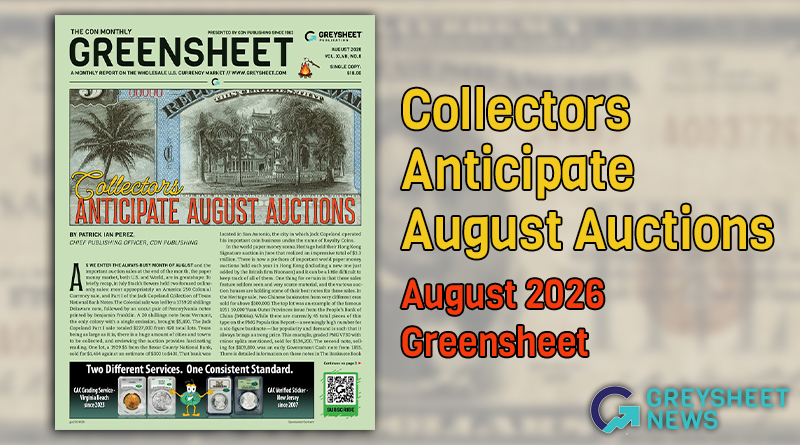
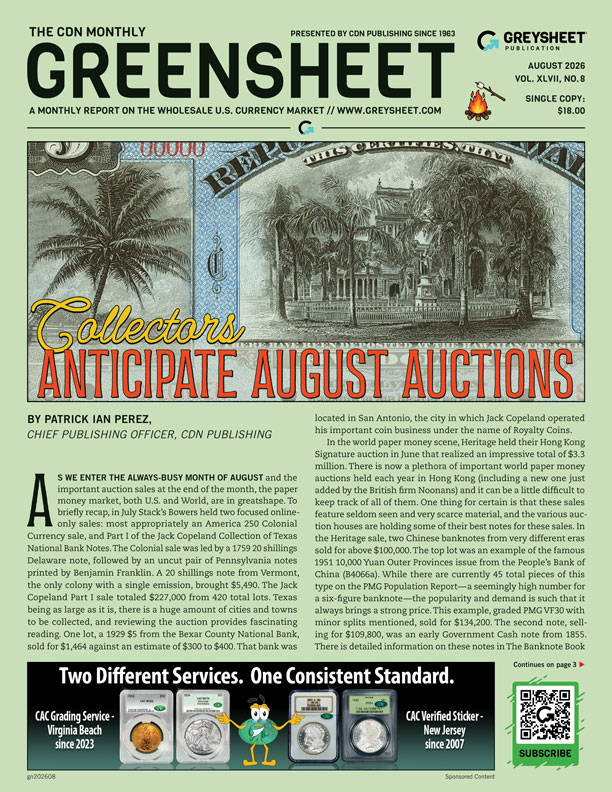
As we enter the always-busy month of August and the important auction sales at the end of the month, the paper money market, both U.S. and World, are in great shape.
by Patrick Ian Perez |
Published on August 3, 2026

Download the Greysheet app for access to pricing, news, events and your subscriptions.
Subscribe to Greensheet for the industry's most respected pricing and to read more articles just like this.
To briefly recap, in July Stack’s Bowers held two focused online-only sales: most appropriately an America 250 Colonial Currency sale, and Part I of the Jack Copeland Collection of Texas National Bank Notes. The Colonial sale was led by a 1759 20 shillings Delaware note, followed by an uncut pair of Pennsylvania notes printed by Benjamin Franklin. A 20 shillings note from Vermont, the only colony with a single emission, brought $5,490. The Jack Copeland Part I sale totaled $227,000 from 420 total lots. Texas being as large as it is, there is a huge amount of cities and towns to be collected, and reviewing the auction provides fascinating reading. One lot, a 1929 $5 from the Bexar County National Bank, sold for $1,464 against an estimate of $300 to $400. That bank was located in San Antonio, the city in which Jack Copeland operated his important coin business under the name of Royalty Coins.
In the world paper money scene, Heritage held their Hong Kong Signature auction in June that realized an impressive total of $3.3 million. There is now a plethora of important world paper money auctions held each year in Hong Kong (including a new one just added by the British firm Noonans) and it can be a little difficult to keep track of all of them. One thing for certain is that these sales feature seldom seen and very scarce material, and the various auction houses are holding some of their best notes for these sales. In the Heritage sale, two Chinese banknotes from very different eras sold for above $100,000. The top lot was an example of the famous 1951 10,000 Yuan Outer Provinces issue from the People’s Bank of China (B4066a). While there are currently 45 total pieces of this type on the PMG Population Report—a seemingly high number for a six-figure banknote—the popularity and demand is such that it always brings a strong price. This example, graded PMG VF30 with minor splits mentioned, sold for $134,200. The second note, selling for $109,800, was an early Government Cash note from 1855. There is detailed information on these notes in The Banknote Book China chapter that is unavailable in English anywhere else. These notes were issued by the Qing Emperor Xian Feng as a result of the Taiping Rebellion and were the first paper money printed in China since the original Ming Dynasty notes 400 years prior. They were issued with two distinct titles: Great Qing Dynasty Note and Board of Revenue Government Note. The Qing notes were denominated in cooper cash coins and the Government notes were denominated in silver tael coins. The Government notes were intended to circulate outside of the capital (Beijing) region, in the provinces and by the military. The note that Heritage sold was issued for the Yunnan province, and the most interesting aspect is that it is denominated in 2,000 copper cash, not silver taels (at the time of issuance, 2,000 copper cash was equivalent to 1 silver tael.) My theory is that local provincial officials were given the option to denominate in either metal, especially since it was likely that silver was very scarce in circulation. Another reminder that there is much to still discover and research when it comes to world paper money.
Two other notes from the Heritage sale that have much appeal to American collectors were two Republic of Hawaii specimens that each sold for $67,100. Both were in the denomination of Five Dollars, one redeemable in gold and the other in silver and were engraved and printed by American Bank Note Company. Surprisingly, both notes are the sole graded by PMG, while other denominations within the same respective series have multiple examples. It is very likely that these specimens trace to the original American Bank Note Company archive sales in the 90s.
The Banknote Book has had numerous updates and publications in recent months. First and foremost, no other paper money catalog in existence is more current with the latest note issues and varieties from around the world; this has always been the standard. If collectors want to truly stay informed of all possible signature varieties, dates, serial number prefix and suffix varieties, subtle design changes of a given country, The Banknote Book is the only place to find that information. Other catalogs may try to update occasionally, but they are either too far behind to ever catch up or do not have the extensive worldwide network of contributors that Owen Linzmayer has cultivated. Recently we have published the complete Rhodesia chapter, which covers the earliest private banks up through the final issues of the 1960s. The complete Costa Rica chapter is completed, and it is chock full of information and full color images of many notes that are rarely, if ever, seen. Lastly, if you are interested in world paper money, please check out the latest podcast I’ve done with Dennis Hengeveld of Stack’s Bowers, where we discuss the current state of the market.

Related Stories (powered by Greysheet News)
View all news
July is a special month on this year's calendar as we celebrate the 250th birthday of our nation.


The recently concluded Central States U.S. coin auction held by Heritage netted just a hair short of $27 million, an impressive result that yielded numerous price records.
The concept of coin collecting is slowly, but steadily, moving further into the mainstream consciousness.
Please sign in or register to leave a comment.
Your identity will be restricted to first name/last initial, or a user ID you create.
Comment
Comments